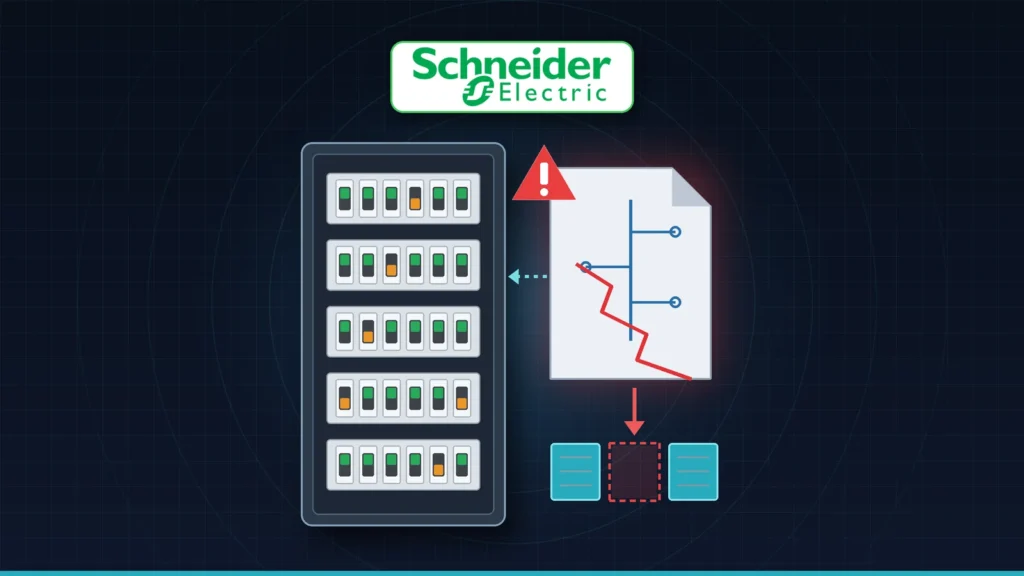
CVE-2026-119055 is a use-after-free flaw in Schneider Electric EcoStruxure Power Build Rapsody that a malicious SSD project file can trigger. Schneider rates it 5.3 under CVSS v3.1 and 4.6 under CVSS v4.0, and no exploitation has been confirmed. Every language edition has its own fixed build, so users must install the one that matches their edition.
| CVE ID | CVE-2026-119055 |
|---|---|
| Product | Schneider Electric EcoStruxure Power Build Rapsody |
| Flaw type | Use after free (CWE-416) |
| CVSS | 5.3 (CVSS v3.1, vendor) / 4.6 (CVSS v4.0, vendor) |
| Exploitation / KEV | No confirmed exploitation |
| Fixed version | See Affected and fixed versions |
What is CVE-2026-119055?
Rapsody is the tool panel builders use to enter or import a single line diagram. It then produces the bill of material for a switchboard, including devices, connection items and mounting parts.
The bug sits in how Rapsody handles SSD project files. According to Schneider Electric security notification SEVD-2026-314-01, a local attacker could trick a user into opening “a specially crafted malicious SSD file.” The result could be arbitrary code execution.
The attack has clear limits. It needs no privileges, but it does need a user to open the file. The CVSS v4.0 vector marks user interaction as Active (UI:A), and the attack vector as Local.
The vendor summary also warns of memory corruption, heap-based buffer overflow and stack-based buffer overflow. However, the advisory assigns only one CVE and one weakness, CWE-416.
The CISA ICS advisory ICSA-26-328-02 lists the affected sectors as Energy, Critical Manufacturing and Commercial Facilities. It says the product is deployed worldwide, and that Schneider Electric is headquartered in France.
Is CVE-2026-119055 being exploited?
No exploitation in the wild or public proof-of-concept has been confirmed. The CVE record for CVE-2026-119055 carries a CISA SSVC assessment that rates exploitation as “none” and the flaw as not automatable. The same assessment rates the technical impact as “total.”
Affected and fixed versions
Schneider ships Rapsody as separate builds for each country or language edition. The version numbers below are copied from the vendor advisory.
| Product | Branch | Affected versions | Fixed version |
|---|---|---|---|
| EcoStruxure Power Build Rapsody | FR | V2.9.1.0 and prior | V2.9.12.0101 |
| EcoStruxure Power Build Rapsody | ESP | V2.8.5.0301 and prior | V2.9.5.0000 |
| EcoStruxure Power Build Rapsody | PT | V2.8.7.0101 and prior | V2.9.7.0000 |
| EcoStruxure Power Build Rapsody | BEL(FR) | V2.8.8.0201 and prior | V2.9.8.0000 |
| EcoStruxure Power Build Rapsody | BEL(EN) | V2.8.3.0201 and prior | V2.9.3.0000 |
| EcoStruxure Power Build Rapsody | INT(EN) | V2.8.4.0401 and prior | V2.9.4.0000 |
| EcoStruxure Power Build Rapsody | INT(FR) | V2.8.6.0000 and prior | V2.9.6.0000 |
| EcoStruxure Power Build Rapsody | NL | V2.8.2.0000 and prior | V2.9.6.0000 |
Schneider notes that the advisory covers only supported versions. Unsupported or extended-support releases may also be affected, and the vendor says it has no obligation to fix them.
How to fix CVE-2026-119055
Install the fixed build for your edition from the table above. Schneider offers the downloads through its Rapsody product country selector.
The vendor asks users to follow normal patch management. Back up systems first, and test the update in a development or offline environment. Contact the Schneider Electric Customer Care Center if a patch needs to be removed.
Schneider lists no specific workaround for this CVE. Because the attack needs a user to open a crafted SSD file, do not open SSD files from untrusted sources on an unpatched installation.
OT systems are often patched slowly, so network controls matter. CISA recommends keeping control system devices off the internet and placing control networks behind firewalls, isolated from business networks. It also advises VPNs for remote access, kept updated. The vendor advisory points to its general cybersecurity best practices, which include restricting physical access and scanning removable media.
How to check if you are affected
Check two things on each workstation: the edition and the build number. The edition code, such as FR, ESP or INT(EN), decides which row of the table applies. A build at or below the affected version for that edition is vulnerable.
Why it matters
Two of the affected builds were once fix builds. In January 2026, the earlier CISA advisory ICSA-26-015-10 named ES V2.8.5.0301 and BEL(FR) V2.8.8.0201 as fixes for CVE-2025-13844. Both builds now appear on the affected list for CVE-2026-119055. Sites that patched in January and stopped there remain exposed.
This is also a recurring pattern. January’s advisory covered a double free (CVE-2025-13844) and an earlier use-after-free (CVE-2025-13845), both triggered by imported SSD files. Counting this one, Schneider has disclosed at least three memory-safety bugs in Rapsody’s SSD file handling during 2026.
The Medium score reflects the need for local access and user interaction. Even so, CISA’s SSVC assessment rates the technical impact as total.
Credit also differs between sources. The vendor advisory credits researcher Michael Heinzl, while the CISA advisory says Schneider Electric CPCERT reported the issue to CISA.
Timeline
| Date | Event |
|---|---|
| October 29, 2026 | CVE-2026-119055 reserved |
| November 10, 2026 | Schneider Electric publishes SEVD-2026-314-01 with fixed builds |
| November 11, 2026 | CVE record published |
| November 24, 2026 | CISA republishes the advisory as ICSA-26-328-02 |